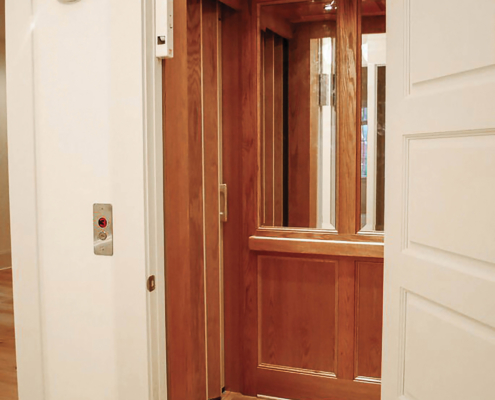
The right choice usually comes down to how many people in the household will use the system, how much your mobility needs might change, and how much of a structural commitment you’re ready to make. Cost matters too, but it shouldn’t be the only factor, since the cheapest option today can end up being the most expensive one if it needs to be replaced in a few years.
Walking through a few common household scenarios tends to make the vertical lift vs home elevator decision clearer than any spec sheet could:
- Single user, stable need, tighter budget: A stair lift or wheelchair stair lift style platform solves the problem quickly without construction or a long installation timeline.
- Shorter rise, like a porch, deck, or split-level entry: A vertical platform lift handles wheelchair or walker access without the footprint of a full elevator shaft.
- Multiple household members or whole-home access needs: A home elevator is typically the only option built to serve the entire household long-term, not just one person.
- Progressive or unpredictable mobility needs: Either a vertical platform lift or a full elevator, depending on how much structural change the home can accommodate.
- Renting or unsure how long you’ll stay in the home: A stair lift tends to be the most cost-conscious and least permanent choice.
Among the many mobility lifts for home use available today, these three cover the vast majority of real-world situations, and none of them is universally “better.” The right one is the one that matches your household now and where you expect to be in a few years.
If your home was built without accessibility in mind, retrofitting an existing structure comes with its own set of considerations, and C.H. Elevator’s retrofit systems are designed specifically for homes that weren’t originally planned around a lift.